
Help *NOT* Wanted
The no hire, no fire job market


It's a challenging job market right now.
For much of 2025 the job market could be summarized as we don't need any more workers. Namely, companies were not laying people off, but they weren't looking to bring on any new help either. It made for a tale of two job markets kind of story. If you had a job you weren't really worried about losing your job. The job market seemed fine. However, if you were looking for a job you had a much harder time finding one, especially if you were young and inexperienced. It has sometimes been referred to as the “no hire, no fire” job market.
There are a number of reasons behind this:
It has been reported that as many as 1/3 of all job postings are fake or ghost job posting for which no one will ever be hired. The reasons for this are varied but that doesn't help those who are wading through it.
Mass layoffs from federal agencies due to the administration’s policy of cutting back the Federal government has placed more of these workers into the normal job pool for the first time ever for some of them.
AI tools are reducing the number of people needed in some jobs which has simply dried up hiring for a number of roles.
Administration policies around tariffs, funding cuts, and immigration uncertainties are causing companies to pull back on hiring while they wait to see how things play out.
All of this has been happening while the unemployment rate remained low and jobs numbers still remained OK.
That all changed last month of course when we received a weak July jobs report accompanied by major revisions to the previous two months that made the late spring and early summer job market look very weak. That report alone is likely what precipitated the Fed to signal a potential pivot on interest rates at the Jackson Hole Conference.
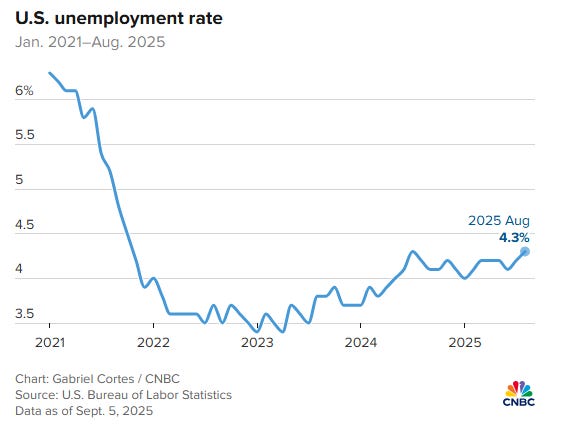
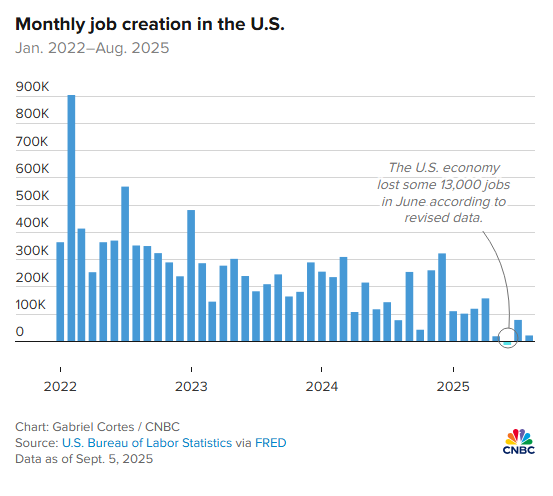
Today we got the August jobs report and it was even weaker with only 22,000 jobs created in August vs 75,000 expected, and a revision down another 27,000 to the June number which actually made June a loss of 13,000 jobs. That ended the second longest string of increasing jobs in US history at 51 months. The unemployment rate also increased to 4.3% which equaled the highest previous rate this cycle from July of 2024. You have to go back to October of 2021 to find a higher rate when we were coming off the pandemic unemployment spike. This is two months of stall speed for the job market. That needs to be corrected soon because what immediately succeeds a stall is a fall.
Perhaps an even more telling sign of the difficulty of getting a job in this job market is the long-term unemployment numbers. The number of people looking for a job who have been unemployed for over 26 weeks has been rising for 2 and half years off a low of about 1 million. In the last few months it has jumped meaningfully from around 1.5 million to almost 2 million. In the month of August alone it jumped from 1.83 million to 1.93 million. We can see the steepness of the jump the last few months on the chart below. If we exclude the massive and very temporary disruption from the pandemic we can see that we were last at this level way back in 2016 as we were in the middle of a nearly 10 year recovery from the Great Recession. This number is also getting close to previous peaks in this number in 2003 and 1992. This number should not be taken lightly. This is what happens when a job market seizes up and isn't taking on new workers.
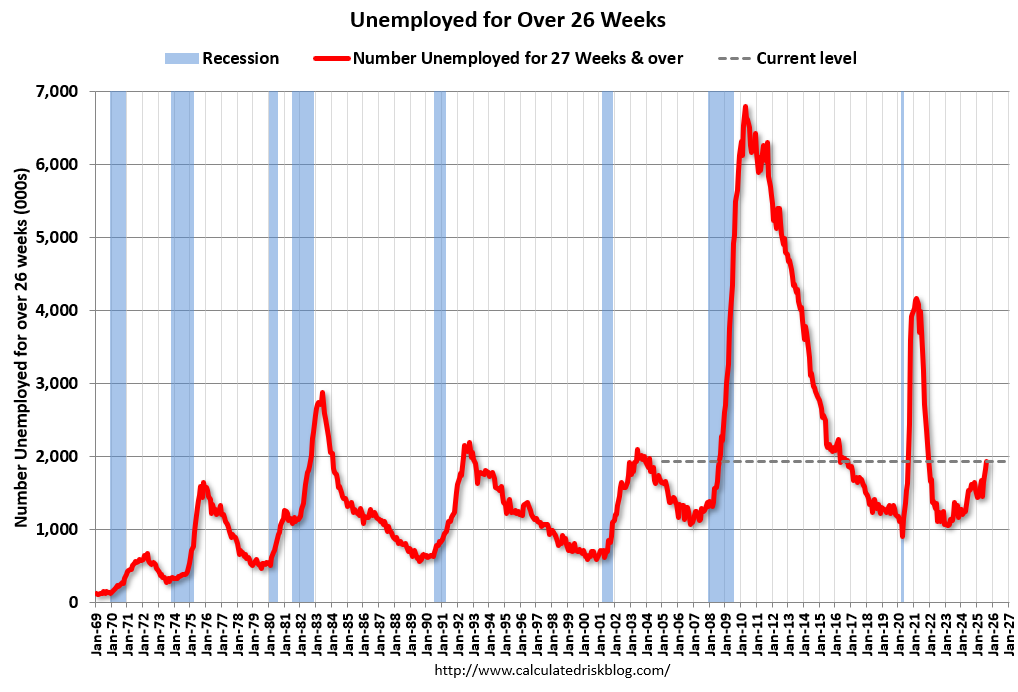
The interesting thing about this is that historically this number has started to rise at the beginning of a recession and has only risen meaningfully after we have been well into a recession, often not peaking until well after we have come out of the recession. This large of an increase has also never happened without a recession previously. We can look at this chart and see that these things have been true without exception for over 50 years.
So typically this is part of what a recession feels like, but we aren't in a recession yet. That may be part of why so many people have felt like we were in one for quite a while now. It feels like a recession when you keep looking for a job and cannot find one.
Based on the list of reasons above that are impacting this current job market, the solutions to this “hiring-freeze” job market are complex and will not be easy to implement over the short term. The Fed lowering interest rates may not be enough as that is not going to address most of the reasons on that list.
Be that as it may, there is little doubt any longer that rate cuts are coming and may be coming faster than previously expected. The job market is not in a healthy place right now. It is currently far from bad, but it is definitely not good. If you don't have a job and need one, then it's probably pretty bad for you right now.
What no one wants to see is a shift to a layoff job market. That would be very bad and would signal a recession is imminent if not already occurring. I think the Fed has seen enough data now to know they don't want the blame for that, so the rate cuts are coming whether they will help or not.
Apex, I was thinking earlier about your AH postings and how there are very few comments, which you might perceive as a lack of interest, although perhaps not. Apparently controversy begets comments (i.e. this topic in MMM), whereas agreement or absorption doesn't. I'm assuming SS provides engagement statistics to you so you can see how many views a topic gets, but my perception is that it's nice to have readers like or comment. Thanks for your ongoing distillations.